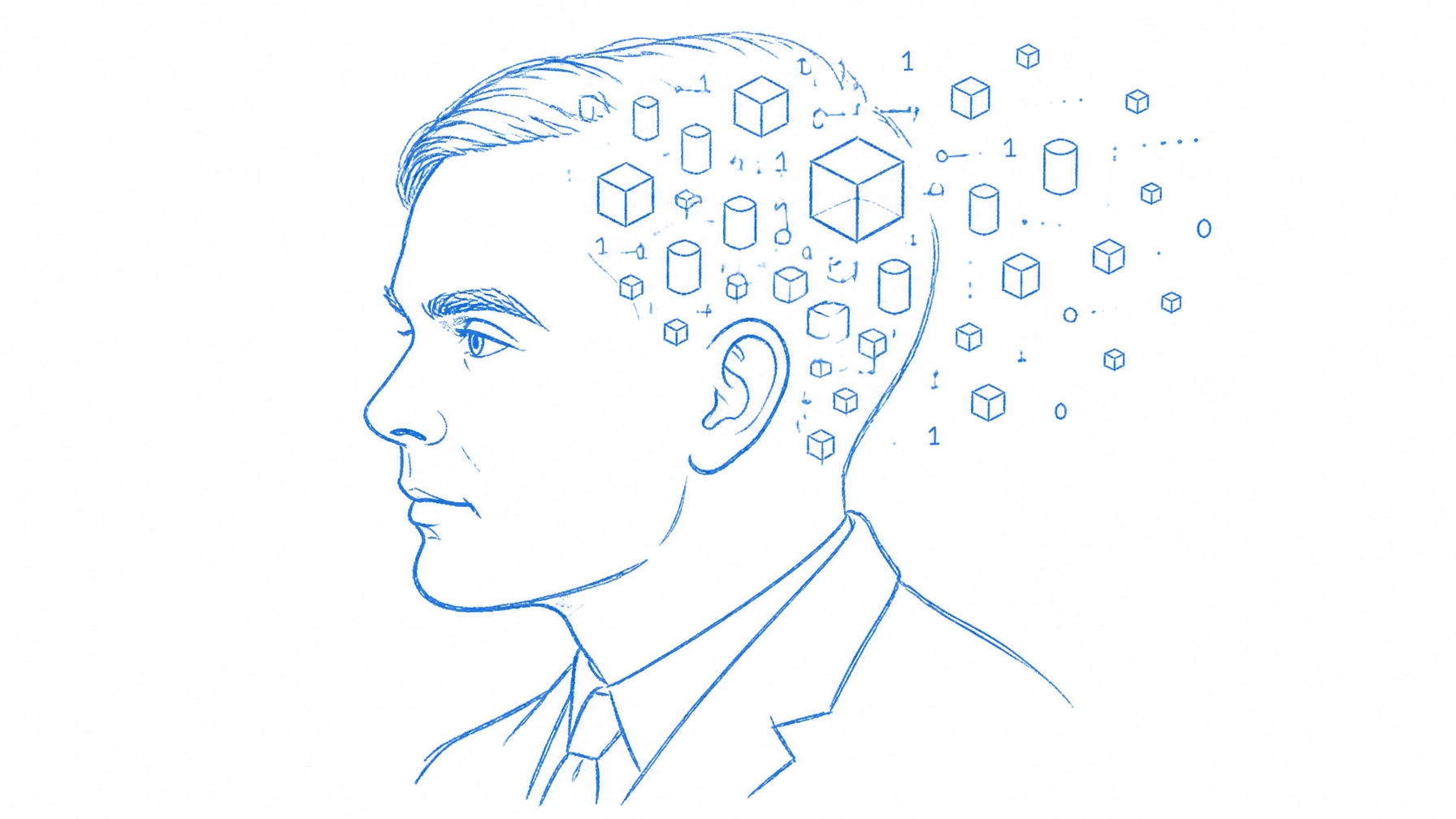
You probably wouldn't be reading this without Alan Turing.
Every time you type a prompt into an AI or check your email, you are using a machine built on his logic. He didn't just build a computer; he invented the very idea of what a computer could be. But history isn't just about code and circuits. It is about people.
Turing was a hero who helped win a world war. He was a visionary who asked if machines could think long before a single transistor existed. He was also a man broken by the very government he saved.
His story is a warning for our digital age. It shows what happens when powerful systems: whether they are legal codes or software codes: are used to persecute instead of protect.
Check your history. Understand the foundation. Here is the life and legacy of Alan Turing.
1. The Blueprint for Everything: The Turing Machine
In 1936, the world was still decades away from the first digital computer. Most "computers" were actually people: often women: doing math by hand.
Alan Turing changed that with a paper.
He imagined a machine. It wasn't made of metal. It was a thought experiment. He called it a "Universal Machine." It had a long tape with symbols on it and a head that could read, write, and move.
Try to picture it:
- A tape divided into squares.
- Symbols representing instructions.
- A machine that changes its behavior based on what it reads.

This was the "Turing Machine." It proved that a single machine could perform any task if you gave it the right instructions. That is the definition of software. Every app on your phone is just a very fast, very complex version of Turing’s tape.
He didn't stop at math. He looked at the machine and saw potential. He saw a mind.
2. The Secret War: Breaking the Enigma
When World War II broke out, Turing went to work for the British government at Bletchley Park. His mission? Break the Enigma.
The Enigma was a German cipher machine. It was thought to be unbreakable. It used a series of rotors to scramble messages into billions of possible combinations. The Germans changed the settings every single day at midnight.
The stakes were absolute:
- Allied convoys were being sunk in the Atlantic.
- Intelligence was dark.
- Conventional codebreaking was too slow.
Turing built a machine to fight a machine. He called it the "Bombe."

Check the results:
By 1942, Turing’s team was decoding roughly 84,000 messages every month. Historians estimate his work shortened the war by at least two years and saved over 14 million lives.
Wait! Despite this, Turing couldn't tell anyone what he had done. His work was classified. He was a war hero in total silence.
3. "Can Machines Think?" The Birth of AI
After the war, Turing turned his attention to the future. In 1950, he published a paper called "Computing Machinery and Intelligence."
He started with a simple question: "Can machines think?"
He knew "thinking" was too hard to define. So, he proposed a test. He called it the "Imitation Game." We now call it the Turing Test.
Unlock the logic:
- A human sits in a room and communicates with two others via text.
- One is a human. One is a machine.
- If the human can't tell which is which, the machine has "passed" the test.
Turing wasn't just interested in clever chat. He was interested in learning. He suggested that instead of trying to program an "adult" mind, we should program a "child" mind and let it learn from experience.
This is exactly how modern Large Language Models (LLMs) work. We feed them data, and they learn patterns. Turing predicted your AI assistant 70 years before it arrived.
4. The Betrayal: When the State Turns on the Individual
Turing was a genius. He was a hero. He was also a gay man.
In 1952, Britain was a place of deep legal prejudice. Homosexuality was a crime. When Turing reported a burglary at his home, the police discovered his relationship with another man.
The system moved quickly:
- He was charged with "gross indecency."
- He was given a choice: prison or "chemical castration."
- He chose the treatment: estrogen injections designed to "cure" his orientation.
The government he saved stripped him of his security clearance. They labeled him a security risk. They monitored his movements. They destroyed his career and his dignity.
Oops. The "logic" of the state at the time was that his identity made him a liability. It was a failure of governance. It was a failure of ethics.
5. The Tragic End: A Poisoned Apple
On June 7, 1954, Alan Turing died. He was 41 years old.
He was found in his bed with a half-eaten apple next to him. The cause of death was cyanide poisoning. The official ruling was suicide.

Some historians believe it may have been an accidental inhalation of fumes from a home experiment. Others see it as the final act of a man broken by state-sponsored torture.
Regardless of the cause, the world lost its greatest mind because a government prioritized prejudice over people.
It took decades for the truth to surface. It took until 2009 for a British Prime Minister to issue a formal apology. It took until 2013 for Queen Elizabeth II to grant him a posthumous pardon.
Too late for Turing. But not too late for us.
6. Why This Matters for AI Legislation Today
You might be wondering: "Why are we talking about 1954 when we’re worried about AI in 2026?"
Because Turing’s life is a case study in algorithmic bias and authoritarian control.
When we talk about "AI Governance," we aren't just talking about code. We are talking about who has the power to define what is "normal," what is "safe," and who gets to participate in society.
Look at the parallels:
- Discrimination: If an AI is trained on biased data, it can automate the same kind of prejudice that destroyed Turing.
- Privacy: Government surveillance, fueled by AI, can target marginalized groups with terrifying efficiency.
- Accountability: Who is responsible when a system: legal or digital: causes harm?
Turing’s story reminds us that technology is never neutral. It is always a reflection of the people who build it and the laws that govern it.
7. Take Action: Guide the Future
We are at a crossroads. AI is the most consequential conversation of our time. It has the power to move us forward, or it can be used to entrench the same old injustices.
At AI For All of Us, we believe you shouldn't just be a user of AI. You should be a guide.

Try this today:
- Check the news: Look up the latest on the AI Kill Switch Act.
- Join the conversation: Don't let tech billionaires be the only ones talking to Congress.
- Stay informed: Read our resources on how to influence AI policy.
Alan Turing gave us the tools to build a better world. It is our job to make sure the laws we write are as brilliant as the machines he imagined.
Reload your perspective. Speak up. Let's build AI for all of us.